




Appointments
Request Appointment/Request Exam - After completing the respective forms, these requests will be processed by our services, and you will receive confirmation by email. The indications about the Agreements (Insurance/Subsystem) are merely informative, please request confirmation in the "Observations" field.
Schedule Appointment/Exam myHPA - By accessing myHPA Saúde you can make the appointment in real time, directly on the Doctor's schedule according to his availability.
You can also contact us at +351 282 420 400 Algarve | +351 269 630 370 Alentejo | +351 291 003 300 Madeira
Phone booking/service hours:
Monday to Friday: 8:00 AM to 7:00 PM, Saturday: 8:00 AM to 5:00 PM Sunday and Holidays: Closed
(National landline)
Your request has been successfully received. We will confirm your appointment shortly.
Download myHPA Saúde:


Gallbladder Stones (Cholelithiasis)
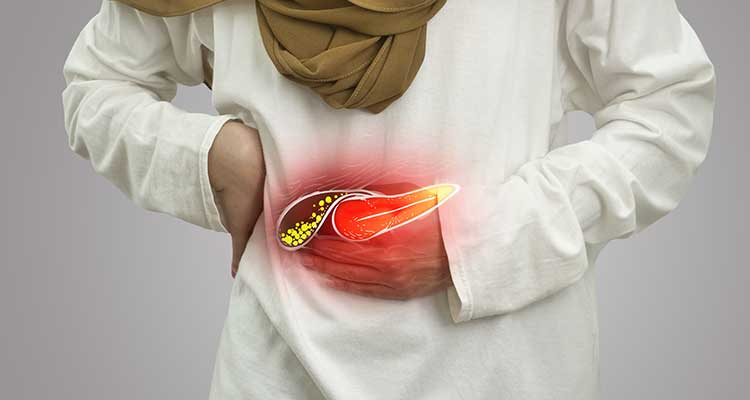
Gallbladder stones, or cholelithiasis, refer to the presence of calculi (“stones”) in the gallbladder, a small organ located beneath the liver that stores bile. After meals, the gallbladder contracts and releases bile into the small intestine, aiding fat digestion.
This is a common condition: approximately 10% of the European population has gallstones, with a higher prevalence in women and increasing incidence with age.
Symptoms
Most patients (around 80%) are asymptomatic. When symptoms occur, they include:
- Pain or colic in the upper right abdomen, which may radiate to the back, chest or left side;
- Sudden episodes of pain lasting minutes or hours, sometimes occurring at night;
- Nausea, vomiting, sweating and pallor associated with pain.
Stone formation occurs due to an imbalance in bile components, particularly cholesterol and bile pigments, or incomplete emptying of the gallbladder.
Risk factors include:
- Obesity;
- Diet high in animal fats and low in fruits and vegetables;
- Physical inactivity;
- Rapid weight loss;
- Prolonged fasting;
- Use of hormones or contraceptives;
- Advanced age, female sex, family history, diabetes, pregnancy, haemolytic anaemias and cirrhosis.
Abdominal ultrasound is the most appropriate diagnostic test and may be complemented by abdominal CT. Many cases are discovered incidentally during imaging performed for other reasons.
Treatment of gallbladder stones depends on the presence of symptoms and the risk of complications. In asymptomatic patients, only 15–25% will develop symptoms or complications over the following 10–15 years, so treatment is not always necessary. In symptomatic patients or those at high risk, surgical removal of the gallbladder (cholecystectomy) is the treatment of choice, preferably via the laparoscopic approach, as it is less invasive and allows faster recovery. Other therapeutic options, rarely used, include medical dissolution of stones or shock-wave fragmentation (lithotripsy), while stones in the bile ducts may require endoscopic intervention (ERCP).
Prevention of gallstone disease is based on correcting risk factors, including maintaining a healthy body weight, adopting a balanced diet rich in fruits and vegetables and low in animal fats, engaging in regular physical activity, and cautious use of hormones and contraceptives.
- Dra. Ana Margarida Vieira
- Dr. André Sancho Ramos
- Dr. Bruno Peixe
- Dra. Helena Tavares de Sousa
- Dra. Maria Margarida Sampaio
- Dra. Patrícia Queirós
- Dra. Ana Rita Herculano
- Dr. André Sancho Ramos
- Dr. Diamantino Sousa
- Dr. Francisco Açucena
- Dr. Horácio Guerreiro
- Dr. Mário César
- Dr. Horácio Guerreiro
CUF Alvor Hospital
CUF Faro Hospital
Hospital São Camilo - Portimão
CUF S. Brás de Alportel Clinic
| Find all the information regarding Specialities and Consultations at CUF Healthcare Units in Greater Lisbon, the North, Centre, and the Azores here. |